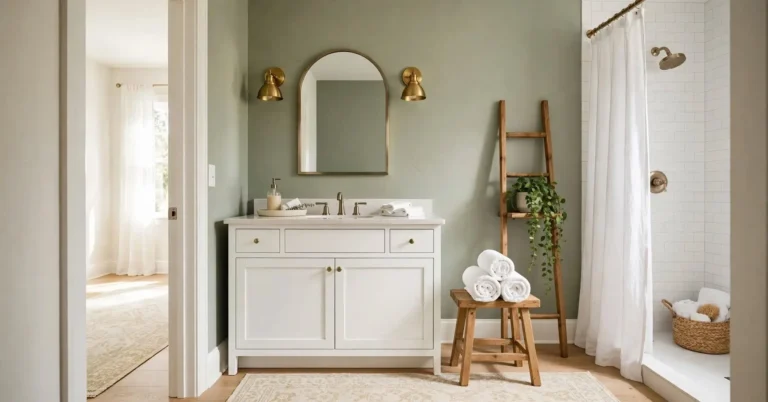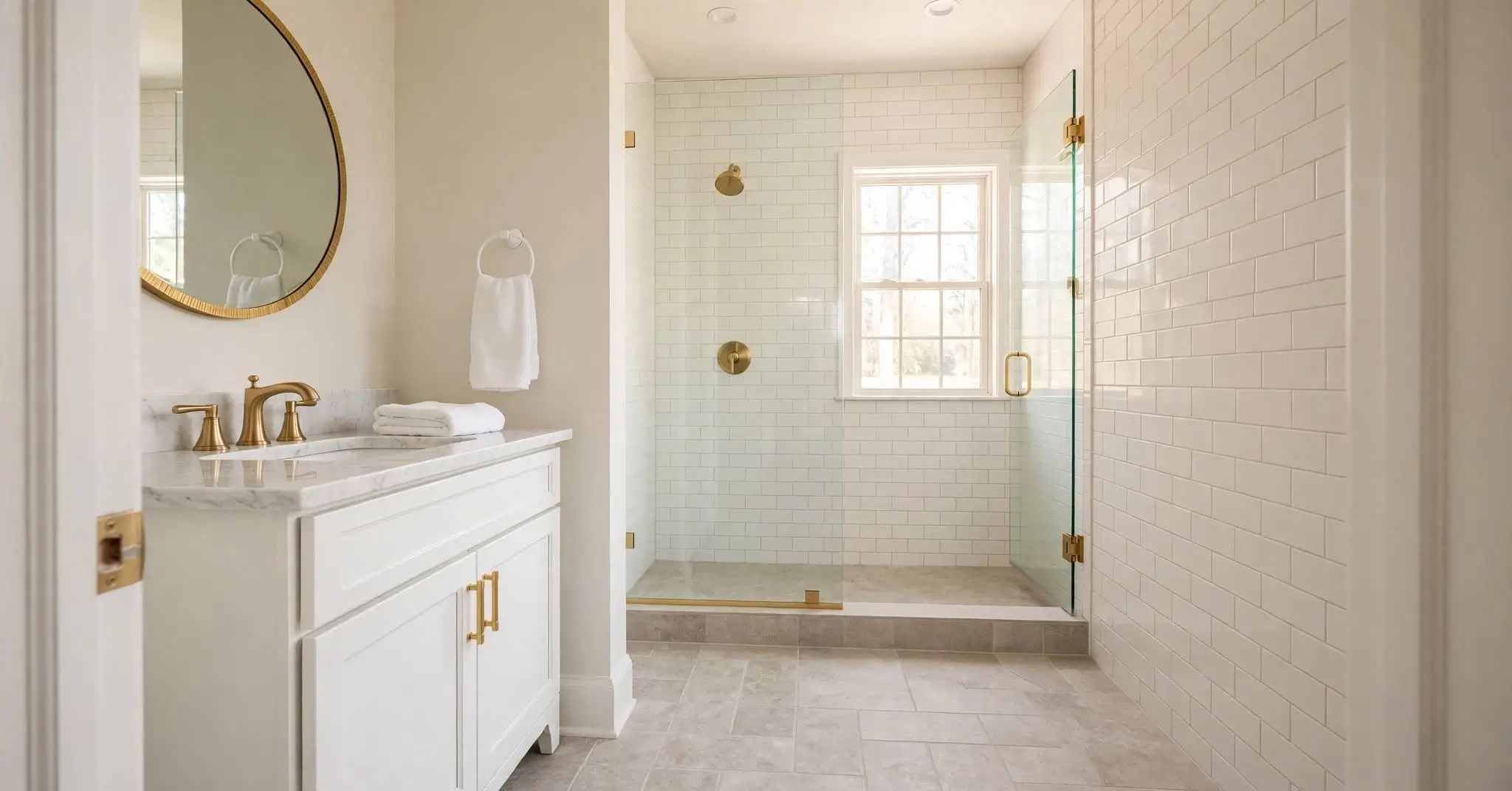
A gold bathroom looks best when gold is a decision, not an accident: one warm finish, repeated in a few places, with white, stone, or a deep color doing the rest. Ten gold bathroom ideas follow, from white and gold to Art Deco, along with the choices that make them work: which finish to buy, how to match gold across different makers, how to mix it with chrome or black, how to budget, and how to keep it clean.
Layout, tile, and vanity choices for the whole room are a separate decision, best made with bathroom ideas for every size and budget in hand.
Is a Gold Bathroom Still in Style?
Yes, as long as the gold is the right kind. Shiny, bright brass is the look closely tied to 1980s bathrooms. Three widely sold gold finishes from major makers are brushed or muted: Kohler’s Vibrant Brushed Moderne Brass, Moen’s Brushed Gold, and Delta’s Champagne Bronze. That tells you how to keep a gold bathroom current: pick a softer finish, keep it consistent, and use it with restraint.
What Tends to Look Dated
- Bright, shiny brass on every fixture.
- Several slightly different golds in one room, which usually happens by accident because finish colors vary from maker to maker.
- Gold everywhere with no matte surface, such as plaster-look walls, stone, or matte tile, to give it contrast.
What Keeps It Current
Brushed or satin finishes, one gold family used throughout, and a calm base of white, stone, or a deep color. Gold works best in the places the eye lands first: the faucet, the mirror frame, the lights, and the vanity hardware.
Which Gold Bathroom Look Fits You?
Once you know gold can work, match your situation to a starting point.
| Your situation | Best look | Best finish | Start with |
| You may sell within a few years | Gold accents on a neutral base | Brushed gold or champagne bronze | Cabinet pulls and a mirror frame |
| You are remodeling a primary bath | A full fixture set with white and stone | Brushed gold | Faucet, shower trim, and lighting from one maker |
| You like a vintage or period look | Warm, aged metal | Unlacquered brass or antique gold | Faucet and bath fixtures |
| You want drama | Gold against a dark color | Brushed gold | Mirror frame and sconces |
| You are unsure about gold | Gold mixed with a neutral metal | Brushed gold with matte black or nickel | Vanity hardware only |
| You have a small powder room | One bold gold statement | Polished or brushed gold | A pair of sconces or a framed mirror |
Gold Bathroom Styles to Copy
These ten looks show how gold behaves with different partners. If you are still choosing a style for the whole room, bathroom theme ideas compare 15 options by cost, upkeep, and room size.
White and Gold Bathroom
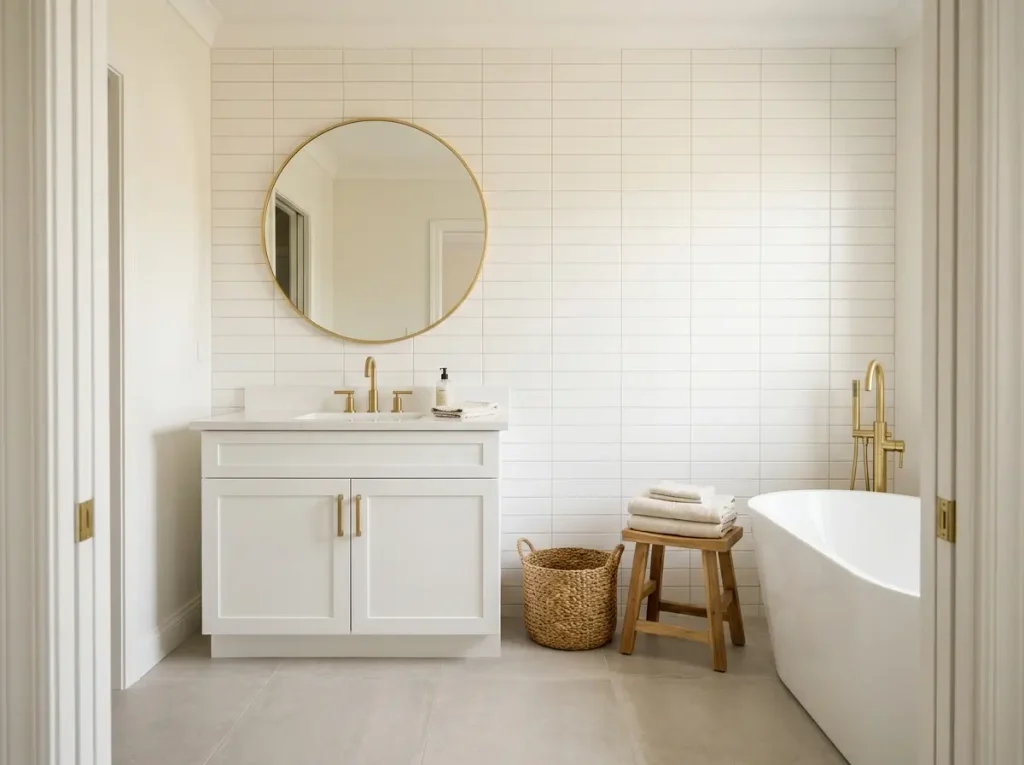
White tile, a white vanity, and gold fixtures make the cleanest version of the look. Crisp white suits shiny gold, while warmer whites suit brushed brass, so match the white to the finish you pick. Add texture, such as wood or woven fabric, so an all-white and gold room does not feel blank.
Marble and Gold Bathroom
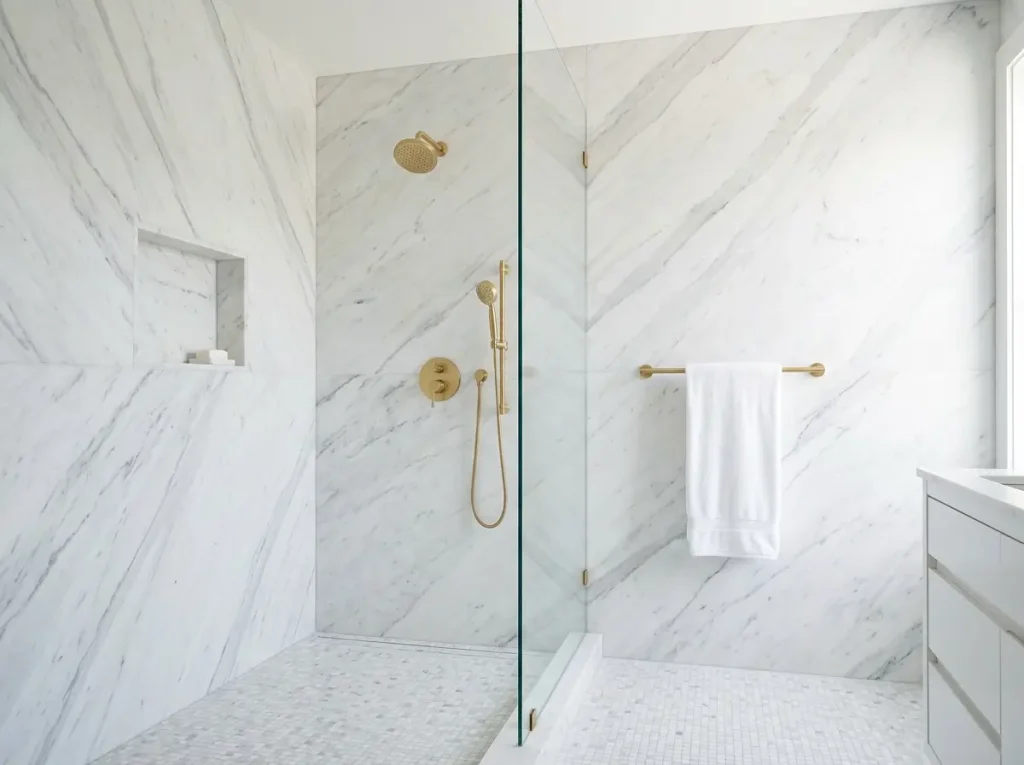
Marble with soft gray or white veining suits gold well. Let the marble lead and keep the gold in a supporting role, since two strong materials compete when both are loud.
Natural Wood and Gold Bathroom

A wood vanity, open shelf, or wood-framed mirror adds warmth that brushed gold picks up, and the pairing feels relaxed instead of formal. Wood can also bridge gold and cooler metals, which helps if you plan to mix finishes later.
Deep Green, Navy, and Gold
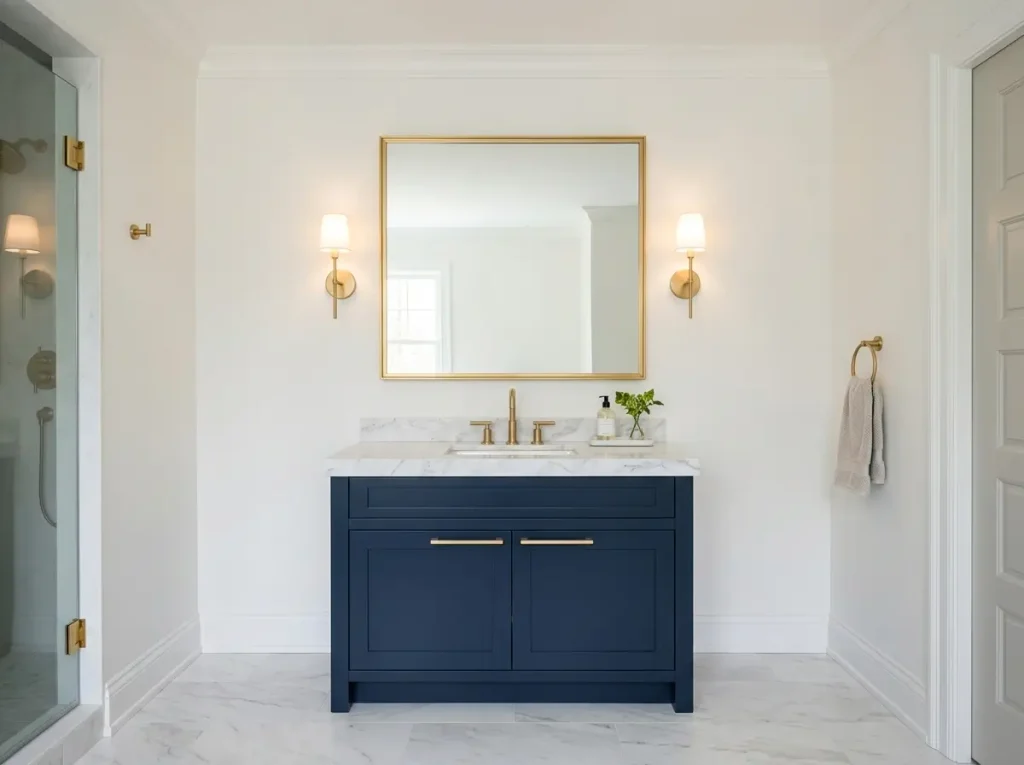
Jewel tones make gold stand out. A forest green or navy vanity with brushed gold pulls adds color without painting the whole room. Deep colors need good lighting near the mirror, so plan the lights before you pick the paint.
Matte Black and Gold
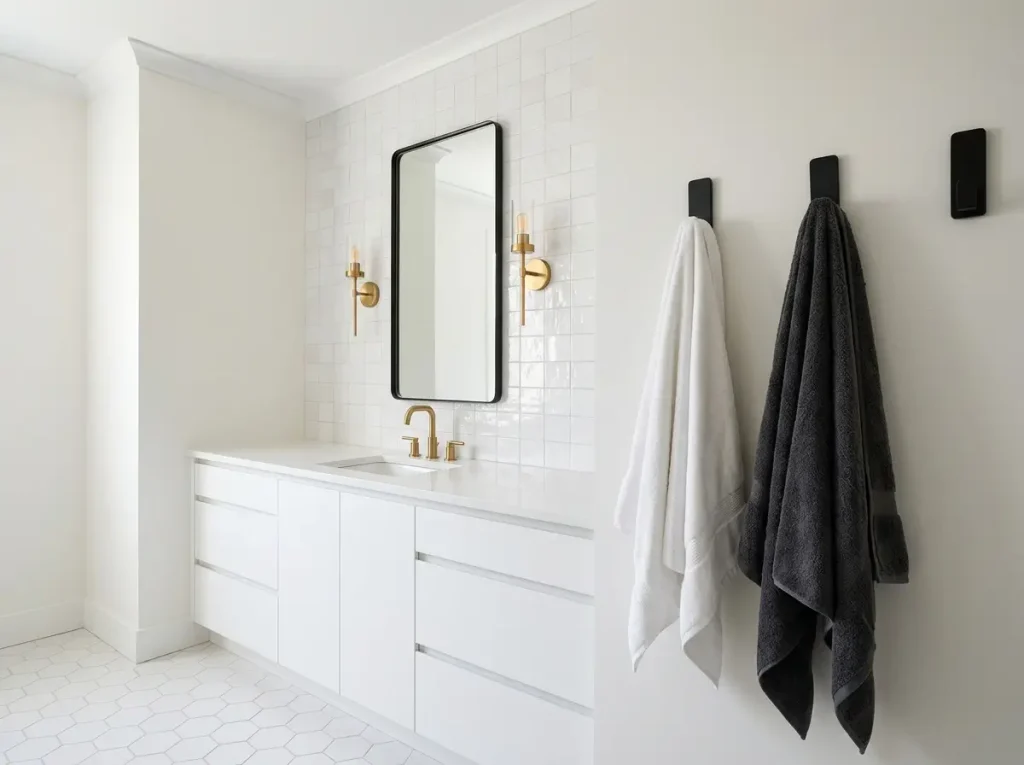
Matte black frames, hooks, or a vanity with brushed gold fixtures give strong contrast, and black is often used as the bridge between warm and cool metals. Keep the gold to the faucet and sconces, and use black for the mirror frame and hooks. Black bathrooms often rely on brass or gold to add glow. If you want a fully dark room rather than a few black accents, picking the right black comes first, and black bathroom ideas start there.
Chrome Fixtures With a Gold Mirror
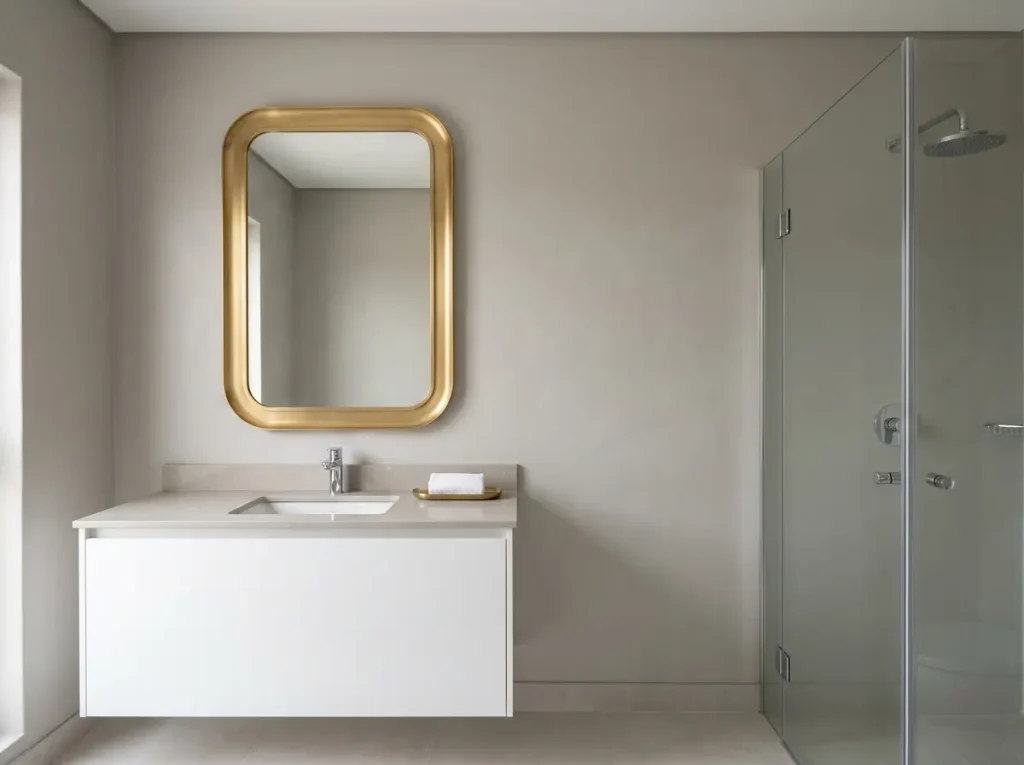
If you are not ready to put gold on the plumbing, keep chrome on the faucet and shower system and let gold show up in a framed mirror, lights, and small accessories. Designers have used a gold-framed vanity mirror with chrome sconces and faucets in soft neutral bathrooms, and it reads as a focal point instead of a full gold scheme. Mixing metals follows a few simple rules, which come after the section on matching fixtures.
Blush Pink and Gold
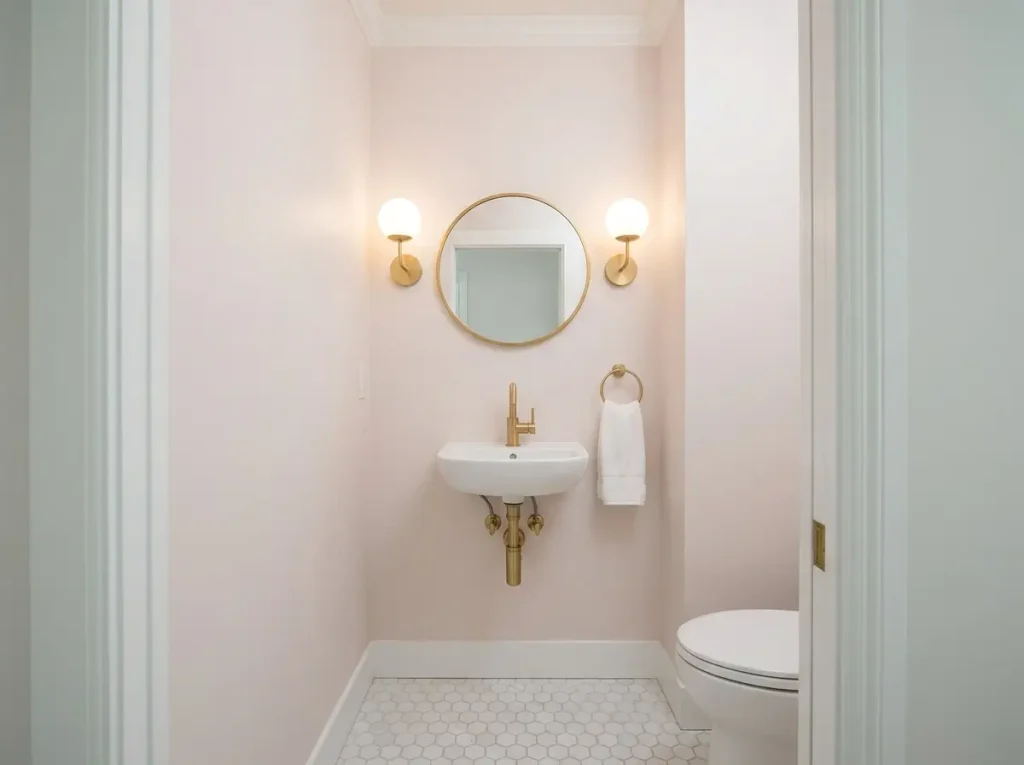
Soft pink walls or tile with gold fixtures feel warm and a little playful, and lighter pinks keep the room calm. This pairing suits a powder room or guest bath.
Art Deco Gold Bathroom
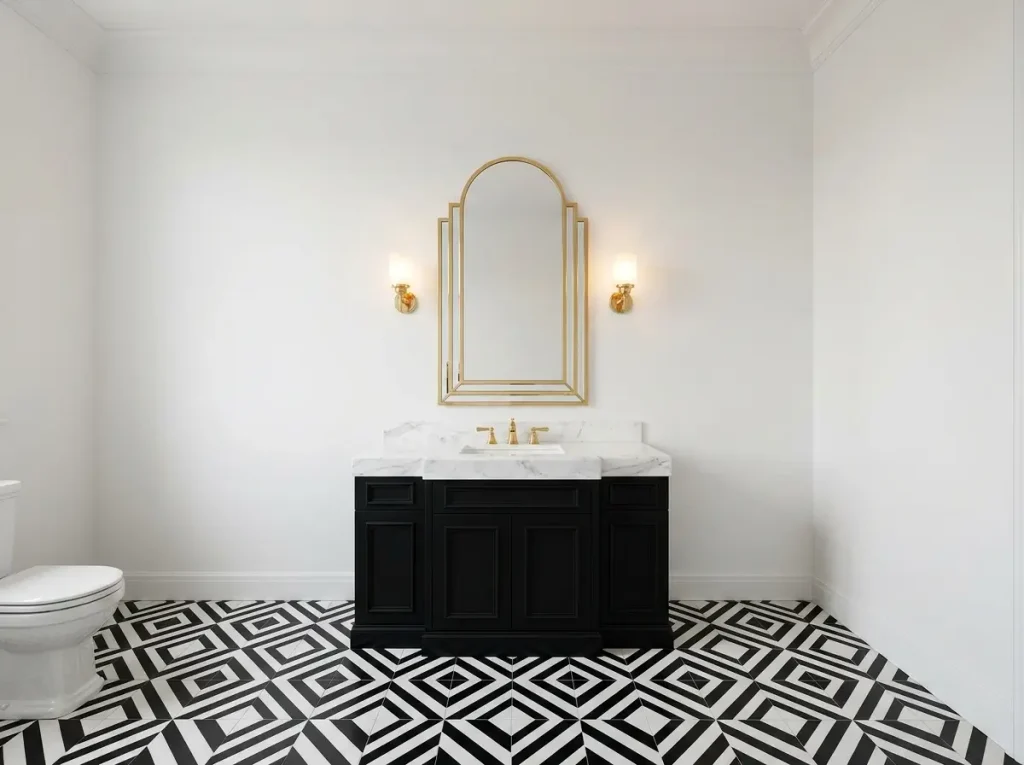
Art Deco bathrooms combine gold, black, and white with bold geometric patterns, often with reflective surfaces such as mirrors and marble. Put the pattern on one surface, either the floor or one wall, and keep the rest simple.
Industrial Bathroom With Gold Fixtures
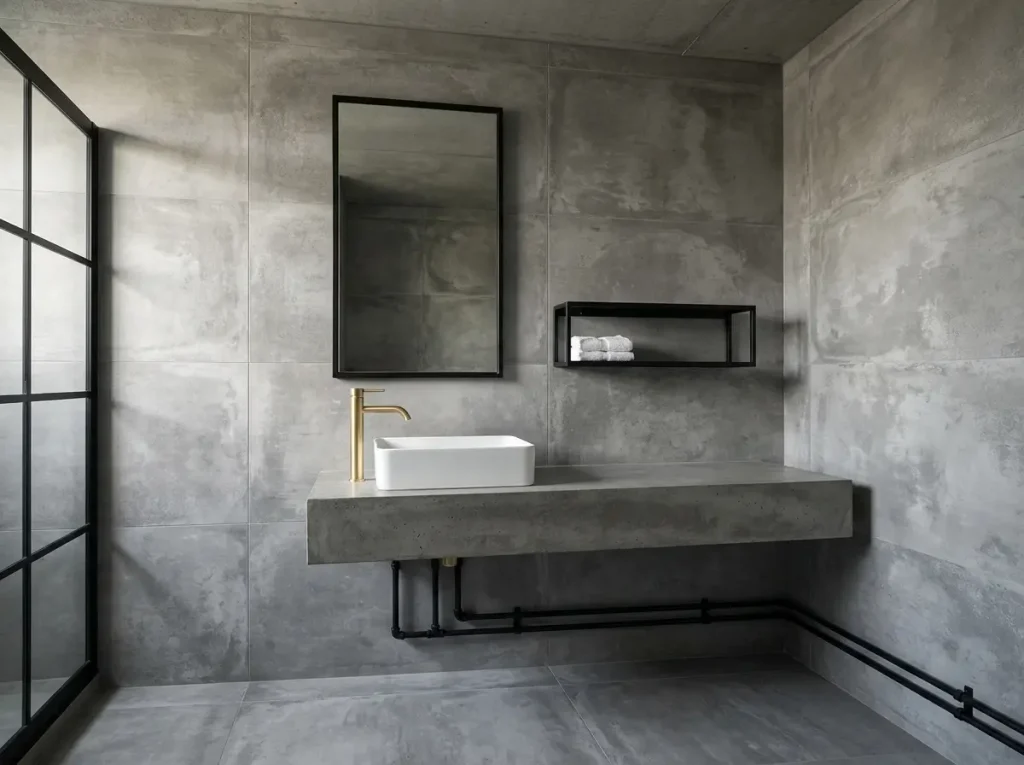
Concrete, exposed pipes, and black metal can feel cold. Brushed gold adds warmth against them, and its textured surface suits industrial details.
Transitional and Modern Farmhouse With Gold
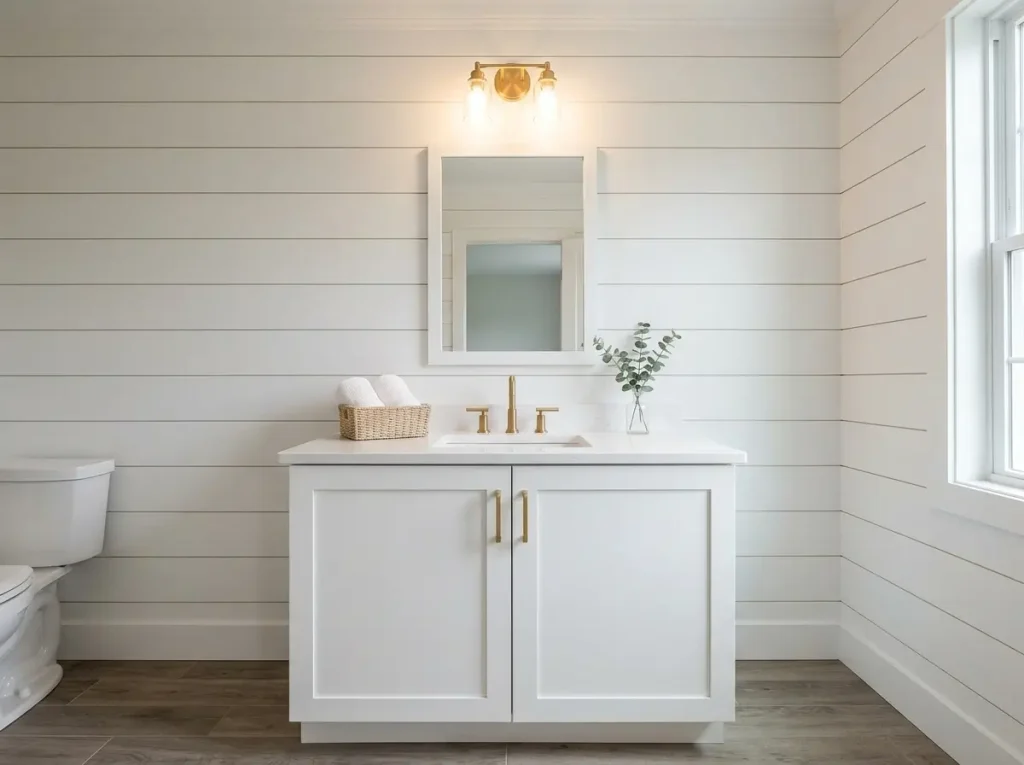
A shaker-style vanity with simple pulls and gold on the hardware and lights is an easy formula. Three or four gold pieces are enough to read as a plan.
Whichever look you choose, the finish decides how it turns out.
Gold Finishes Explained
Gold is not one color, and finish names are not standardized. The finish decides how warm the metal looks, how it ages, and how much wiping it needs.
| Finish | Look | How it behaves | Best for |
| Brushed gold | Soft brushed texture, low glare | Hides fingerprints and water spots better than polished | Modern and transitional rooms |
| Polished gold | Bright, mirror-like shine | Shows smudges and fingerprints more easily, so it needs more wiping | Formal, glam, and Art Deco rooms |
| Brushed brass | Warm yellow-gold tone with a brushed texture | The brushed texture scatters light, so it glares less than polished | Transitional and farmhouse rooms |
| Lacquered brass | Brass under a clear protective coat | Keeps a consistent color, though the coating can scratch or peel over time | Rooms where you want the color to stay put |
| Unlacquered brass | Warm brass with no coating | Develops a patina and shows water spots and fingerprints more readily | Vintage and period rooms |
| Antique gold | An aged-looking gold | Defined differently by different makers (see below) | Traditional rooms |
| Champagne bronze | Warm, muted gold with a bronze undertone | Reads softer than brushed gold | Transitional rooms and layered warm metals |
Names vary by maker. Antique gold is a clear example: Rohl describes its Antique Gold as a muted bronze tone with a brushed patina, while Samuel Heath describes its Antique Gold as a honey-tone gold with 24-carat plating. Big brands also use their own names, such as Delta’s Champagne Bronze, Moen’s Brushed Gold, and Kohler’s Vibrant Brushed Moderne Brass. Compare samples, not names.
Brushed Gold and Polished Gold
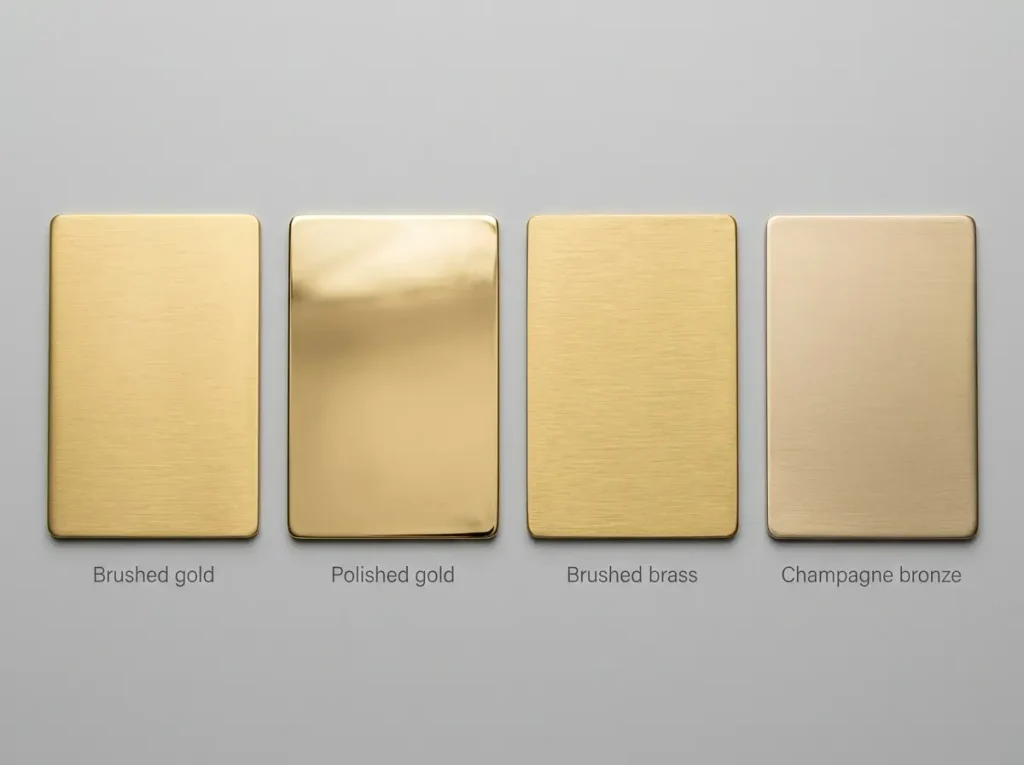
Brushed finishes scatter light instead of reflecting it directly, which makes fingerprints and water spots far less visible. Polished gold shows smudges more easily and needs more frequent wiping to keep its shine. If you want the least upkeep, choose brushed. If you love the bright look, accept the wiping.
Brass, Lacquered and Unlacquered
Brass is the metal itself, and its finish decides how it behaves. Lacquered brass has a clear protective coat that keeps the color consistent, though the coating can scratch or peel over time. Unlacquered brass has no coating, so it develops a patina and shows water spots and fingerprints more readily. Some owners polish it to keep it bright. Others let it darken on purpose. If you want the room to look the same for years, choose lacquered brass or a coated gold finish. If you like metal that ages, choose unlacquered.
Champagne Bronze and Brushed Gold
Champagne bronze is a warm, muted gold that sits between polished brass and rose gold. Brushed gold usually looks clearer and more openly golden, while champagne bronze carries a muted bronze undertone. The two often look interchangeable in online listings but read differently side by side, so use them together only when the difference is deliberate.
How the Finish Is Made: PVD, Plating, and Lacquer
PVD stands for physical vapor deposition. Metal is vaporized in a vacuum chamber and bonded to the faucet at a molecular level. Kohler’s buying guide says PVD finishes resist scratches, corrosion, and tarnishing, and Hansgrohe describes lacquer as durable, but less so than PVD or chrome. Real gold plating needs gentler care: Newport Brass tells owners to treat its 24K gold finishes like fine jewelry. Many gold-toned faucets have a brass body with the color applied as a finish layer. If the product page does not say which process was used, ask the maker before you buy.
How to Match Gold Across Every Fixture
Choosing the finish is the easy part. Matching it across a faucet, a mirror, lights, and hardware is where gold bathrooms get tricky.
Why Golds Clash
Finish names are not standardized, so two pieces both labeled brushed gold can differ in undertone and sheen. Makers also define similar names differently, as the Antique Gold example shows, and finishes such as champagne bronze and brushed gold can look alike online but different next to each other.
Test Samples Before You Buy
Order finish samples or swatches where the maker offers them. Hold them next to each other, then check them in your bathroom in daylight and at night, beside your tile and paint. If two samples look different in your room, they will look different on the wall.
Buy by Collection When You Can
The simplest route is one maker for the faucet, shower trim, and accessories. Some makers sell the same finish across both bathroom and hardware collections, and Samuel Heath says many of its gold finishes run across both for continuity. Others sell bath accessory sets, such as towel bars, robe hooks, and toilet paper holders, built to match their faucets. When you must mix makers, make the pieces that sit side by side match most closely, such as a faucet and the pulls on the vanity beneath it.
Can You Mix Gold With Chrome, Nickel, or Black?
Yes, and mixing is a lower-commitment way to use gold: keep the plumbing in a neutral metal and add gold in smaller pieces. Designers share a few consistent rules.
Rules That Work
- Designers commonly keep a bathroom to two metals. Three can work in a large room, but small rooms get chaotic quickly.
- Use one metal for the main fixtures and the other for accents.
- Balance finishes. If one metal is matte, add a piece with some shine, or the reverse.
- Use black as a bridge. Matte black cabinet knobs work with gold faucets.
Combinations to Try and Combinations to Skip
- Gold with chrome: keep chrome on the faucets and shower system, and put gold on the lights and accessories.
- Gold with matte black: black reads as a neutral, so it pairs easily with warm metals.
- Gold with brushed nickel: gold is a warm metal and nickel is a cool one, which gives contrast. Some designers prefer that contrast in undertone over two similar warm metals.
- Two near-match golds: skip brushed gold next to champagne bronze unless the difference is intentional.
Where to Add Gold, From Easiest to Biggest
If a full gold set feels like too much, start small and build outward.
Cabinet Pulls and Vanity Hardware
This is the easiest place to start, and it is simple to swap back. Measure the distance between your current screw holes before you order, so the new pulls fit without new drilling.
Mirror Frame and Lighting
A gold-framed mirror and a pair of sconces bring gold into the room without touching the plumbing. Pick the mirror shape and sconce placement first, borrowing from bathroom decor ideas for the vanity area, then choose the gold finish to suit them. Keep the mirror and lights in the same finish as each other, even if the faucet is a different metal.
Faucet
Match the faucet to the holes in your sink or vanity top. A single-hole faucet fits a one-hole sink, or a three-hole sink with a deck plate. A widespread faucet has separate handles and a spout across three holes spaced 8 to 16 inches apart, and it will not fit a 4-inch centerset sink. A wall-mounted faucet attaches to the wall instead of the counter, which suits above-counter, wall-mount, and undermount sinks, with or without a deck.
Shower and Tub
Shower heads, handheld showers, and tub fillers are the biggest areas of gold in the room, and they sit in constant water. Ask whether the finish is PVD and what the warranty covers. Read the terms closely, since Moen, for example, says ignoring its cleaning instructions may void the warranty.
Towel Bars, Hooks, and Flush Plates
Small pieces tie the room together, and they are where a mismatch shows. Buy them in the same finish as the faucet when you can, and check a sample against the faucet before ordering.
Gold in Small Bathrooms and Powder Rooms
In a small bathroom, brushed finishes glare less because they scatter light instead of reflecting it directly. Limit gold to the faucet and the mirror frame so it stays an accent. A powder room is the easiest place to go bolder: it is used briefly and has fewer fixtures to match, so a pair of polished gold sconces or a statement mirror can carry the room. Clear floor space and toilet placement matter more than finish in a tight room, and the small bathroom ideas explain the clearances to plan around.
How to Budget for a Gold Bathroom
Prices for gold fixtures change often, so a repeatable method works better than numbers that will age. Three things set the total: the maker and finish process, the number of pieces, and whether you are swapping fixtures or remodeling.
- List every piece you want in gold: faucet, shower trim, tub filler, pulls, mirror, lights, towel bars, hooks, and flush plate.
- Price each piece in your chosen finish from one maker, then from a second maker for comparison.
- Compare the finish process and warranty. PVD costs more up front, and some makers back it with a lifetime finish warranty.
- Check what is included. Some listings include a rough-in valve or a deck plate, and others sell them separately.
- Decide whether this is a fixture swap or part of a remodel. For a remodel, average remodel costs by bathroom size are laid out from small baths to primary baths.
Ways to Spend Less
- Start with pieces that are easy to swap back: pulls, a mirror frame, and lights.
- Choose brushed finishes, which hide fingerprints and water spots and need less wiping.
- Buy matching pieces from one maker to avoid returns caused by mismatched finishes.
How to Clean and Care for Gold Fixtures
Care instructions differ by maker and by finish, so check the maker’s care sheet first.
Everyday Cleaning
Wipe with a soft cloth, mild liquid soap, and warm water. Rinse thoroughly and dry with a soft cloth. Moen’s care instructions for its PVD gold finishes, including Brushed Gold, describe the same routine and ask owners to rinse any cleaner off immediately. Newport Brass and Rohl both specify a soft cloth.
Water Spots and Fingerprints
Pat the fixture dry after use to prevent hard-water spots. Polished gold shows fingerprints and spots fastest, and brushed gold hides them better. Moen also suggests an occasional coat of non-abrasive wax on textured finishes such as Brushed Gold, and notes that wax slightly changes the color, so test a hidden spot first.
What Not to Use
- Abrasive pads, sponges, powders, and steel wool.
- Bleach.
- Ammonia.
- Alcohol and other solvents.
- Limescale removers and other harsh chemicals.
That list is the cautious default, and makers do not agree on every item. Moen’s care page for its PVD gold finishes allows most common household cleaners, advises against limescale removers, and allows 0000-grade steel wool or a half-and-half vinegar and water mix for dried water spots. Rohl also allows a brief vinegar wipe on its PVD finishes and says not to let it soak, while Newport Brass warns that acidic fluids can damage some of its finishes, and California Faucets lists vinegar among the things to avoid on its living finishes. If your maker’s instructions differ from this list, follow your maker’s.
Real Gold Plating
If a fixture has real gold plating, treat it like fine jewelry. Newport Brass advises mild liquid soap only for its 24K gold finishes and warns that abrasive cleaners, pads, and sponges can damage the plating.
Caring for Unlacquered Brass
Unlacquered brass is a living finish, so darkening is normal. California Faucets advises drying living finishes after each use and avoiding abrasive cloths, bleach, vinegar, and solvents. If you want the brass bright again, a polish made for brass restores the shine, but the metal will keep changing afterward.
What to Check Before You Buy Gold Fixtures
Use the same short list on every product page.
- Body material: faucet makers point to brass construction as a sign of durability.
- Cartridge: ceramic disc cartridges are another durability indicator.
- Finish process: PVD, plating, or lacquer. Ask the maker if the page does not say.
- Finish warranty: check its length, and whether the finish counts as a living finish, which is meant to wear and may not be covered.
- Hole count and spacing: match them to your sink or vanity top.
- Samples: find out whether the maker offers finish samples.
Gold Bathroom Mistakes to Avoid
- Choosing finishes by name instead of by sample.
- Putting two near-match golds side by side without meaning to.
- Using more than two or three metals in one room.
- Ordering a faucet without checking hole count and spacing.
- Cleaning with abrasive pads, bleach, or ammonia without checking the maker’s care sheet.
- Expecting unlacquered brass to stay the same color.
Frequently Asked Questions
Is gold still in style for bathrooms?
Yes, in brushed and muted finishes used with restraint. Bright, shiny brass on every surface is the version that looks dated.
What color goes best with gold fixtures?
White, white marble, navy, deep green, and matte black all work well. Pick the partner first, then choose the finish that suits it.
Can you mix gold with chrome or black?
Yes. Designers commonly keep a bathroom to two metals, and matte black works as a bridge between warm and cool metals.
Does gold show water spots?
Polished gold shows spots and fingerprints most. Brushed gold hides them better. Drying the fixture after use helps with either.
What is the difference between brushed gold and brass?
Brass is the metal. Many gold-toned fixtures have a brass body with the gold color applied as a finish layer, while brass finishes show the metal’s own warm yellow tone.
Is gold good for a small bathroom?
Yes, in small amounts. Brushed finishes glare less, and limiting gold to the faucet and mirror frame keeps it an accent.
How much does a gold bathroom cost?
There is no single price. The maker, the finish process, and the number of pieces set the total, so list your pieces and price them in one finish.
Does gold tarnish?
Makers describe PVD finishes as tarnish resistant. Unlacquered brass darkens by design, and real gold plating can be damaged by abrasive cleaning.
Final Thoughts
Gold works when you choose it on purpose: one finish, matched across every piece, with white, stone, or a deep color doing the rest. Test a sample in your own light before you order, since two golds with the same name can look different on the wall. Keep the room to two metals, or three at most in a large bathroom, so the gold reads as a plan instead of clutter. If you are not ready to commit, start with cabinet pulls, a mirror frame, or a pair of sconces, because those are easy to swap back. Once those look right in the room, move on to the faucet and shower in the same finish.

About Author
Hello there. I am Lathen Reed, a home improvement and interior design enthusiast. With a passion for creating beautiful, practical, and comfortable spaces, I share helpful ideas and inspiration related to home improvement, home decor, interior design, and home styling. Through HomeFixStyle, my goal is to make home improvement simple, inspiring, and accessible for everyone.