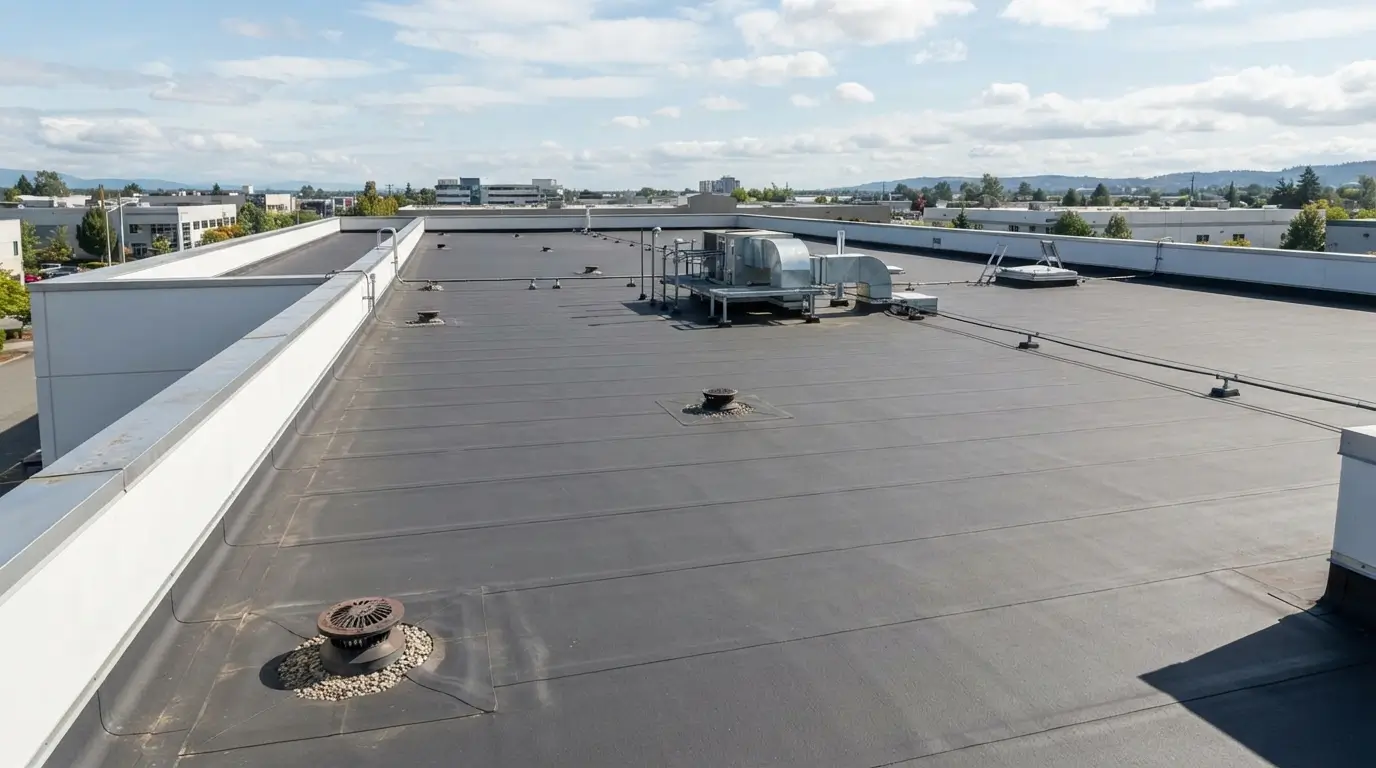
Flat roof maintenance is not complicated, but it is specific. Most flat roofs fail for the same small reasons. A clogged drain sits for months. A cracked pipe boot goes unnoticed. A tiny seam gap opens after a cold winter. None of these problems are expensive to fix early. All of them become expensive once ignored.
This guide covers everything you need to maintain a flat roof the right way. You will learn how to identify your roofing membrane, how often to inspect it, and what actually causes leaks. You will also learn the seasonal tasks that protect your roof, when to call a professional, and how to keep your warranty valid. Every section is built around real standards from roofing authorities, not guesswork.If you own a flat roof, this is the only guide you need to keep it working for decades.
What Are the Flat Roof Maintenance Rules That Actually Matter?
A few rules make up most of what flat roof maintenance actually requires.
- Inspect your roof twice a year. Spring and fall are ideal.
- Water should never sit for more than 48 hours after rain. This is the standard used by the National Roofing Contractors Association.
- Clear your drains and scuppers at least twice a year. Clean them quarterly if trees are nearby.
- Identify your roof membrane before using any sealant or coating. The wrong product can cause serious damage.
- Keep a written record of every inspection and repair. Warranty claims depend on it.
These five habits prevent most of the damage that leads to costly repairs.
What Is Your Flat Roof Made Of? Identify It Before You Do Anything Else
Most homeowners assume their flat roof is rubber. Often it is not. Each membrane type has its own weaknesses and its own maintenance rules.Flat roofs are common on commercial buildings, but they also define the look of many modern residential homes.
| Membrane | How to Recognize It | Typical Lifespan | Common Failure Point |
| EPDM (rubber) | Black or white sheet, glued or taped seams | 20 to 30 years | Seam adhesive failure |
| TPO | White or gray sheet with slight sheen | 20 to 30 years | Weak heat welded seams |
| PVC | White welded sheet, soft feel | 20 to 30 years | Brittleness late in life |
| Modified bitumen | Rolled asphalt sheet, granule surface | 15 to 25 years | Granule loss, seam lifting |
| Built up roofing | Layered felt under gravel | 20 to 30 years | Alligatoring, gravel loss |
| Spray foam | Seamless, always coated | Long if recoated on schedule | Coating erosion |
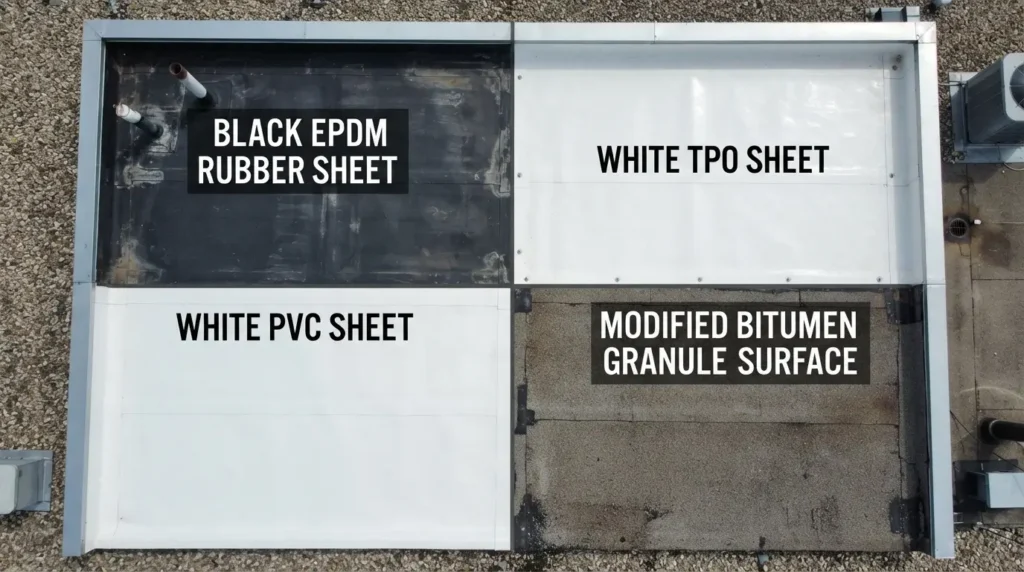
If you are unsure what your roof is made of, take a close photo of a seam and a drain edge. A local roofing contractor can identify it quickly. This single step prevents the most expensive mistake in flat roof maintenance, which is applying the wrong product to the wrong membrane. Good flat roof maintenance always starts with knowing your material.
Which Flat Roofing Material Lasts the Longest?
PVC, TPO, and EPDM generally last the longest, often reaching 20 to 30 years with proper care. Modified bitumen tends to age faster, usually lasting 15 to 25 years. Built up roofing can also reach 20 to 30 years, but it needs more frequent surface inspection. Lifespan always depends on installation quality, climate, and how consistently the roof is maintained.
How to Maintain a Flat Roof: Step by Step
Flat roof maintenance follows a repeatable process. Doing these steps in order keeps nothing overlooked.
How to Safely Access and Inspect Your Roof
Only walk on your roof in dry, mild weather. Wear soft soled shoes. Avoid working during high wind or after rain. If your roof is steep, high, or hard to access safely, hire a professional instead.
How Often Should You Inspect a Flat Roof?
Inspect your roof twice a year at minimum, ideally in spring and fall. Add an inspection after any major storm, hail event, or rooftop service call. Many manufacturer warranties require a professional inspection at least once a year.
How to Clear Debris, Drains, and Vegetation
Leaves, branches, and dirt trap moisture and block water flow. Sweep your roof regularly, especially in fall. Clear every drain, scupper, and gutter by hand. Trim any tree branches that hang over the roof.
How to Check and Test Your Drainage System
Run a hose at each drain and watch how fast it clears. Slow or gurgling drainage usually means a blockage below the surface. Check your secondary or overflow drains too. These only matter during heavy storms, so they are easy to forget.
How to Spot Early Warning Signs
Walk the full surface slowly. Look for blisters, cracks, ridges, and areas that feel soft underfoot. A soft spot usually means wet insulation below the membrane. Check flashing around vents, pipes, and rooftop equipment for gaps or lifting edges.
Basic Repairs You Can Safely Do Yourself
Small, non-structural issues can often be handled without a contractor.
- Clean the damaged area completely.
- Apply a patching material made for your specific membrane type.
- Seal the edges fully to stop water from getting underneath.
Larger cracks, soft decking, or anything under an active warranty should go to a licensed roofer.
Is Standing Water on a Flat Roof Normal?
Some standing water after rain is normal. It becomes a problem when it lasts. The National Roofing Contractors Association defines ponding as water still present 48 hours after rainfall in normal drying conditions. Anything longer signals a drainage or slope issue.
Standing water is more damaging than it looks. A pool just one and a half inches deep can add thousands of pounds to your roof deck. Constant moisture also softens seams and speeds up material aging. Algae and moss often grow in these wet spots, which clogs drains further downstream.
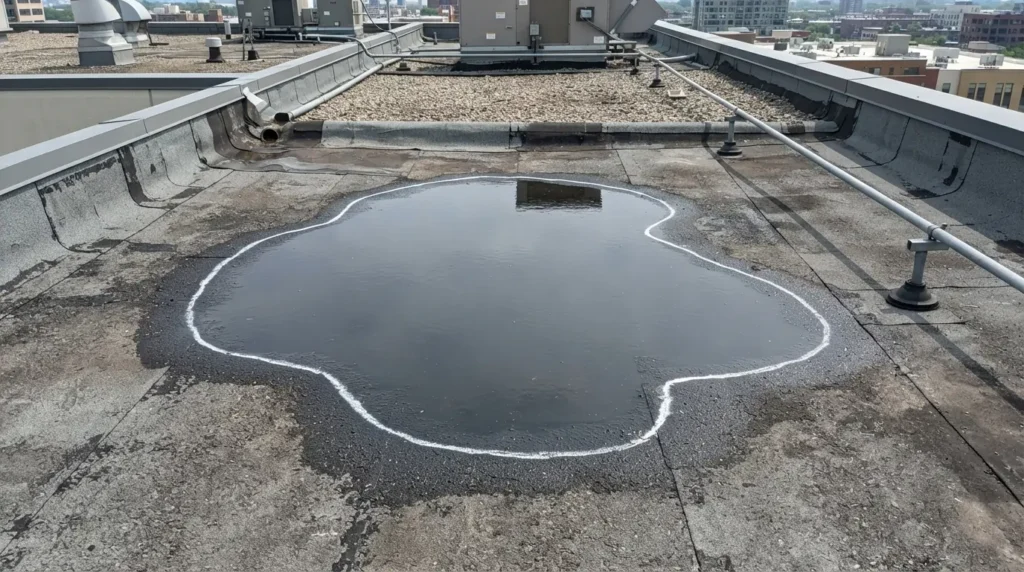
A simple test can confirm the problem. After a steady rain, wait two dry days. Mark any remaining water with chalk and take a photo. If the same shape returns after the next storm, you likely have a drainage problem. Sealant alone will not fix it.
Where Do Flat Roofs Actually Leak?
The open middle section of a flat roof is usually the strongest part. Leaks almost always start at the interruptions.
- Pipe boots and vent penetrations
- Flashing around parapet walls and edges
- Seams, especially those installed in cold weather
- Drain assemblies with loose rings or cracked flashing
- Punctures from other trades working on the roof
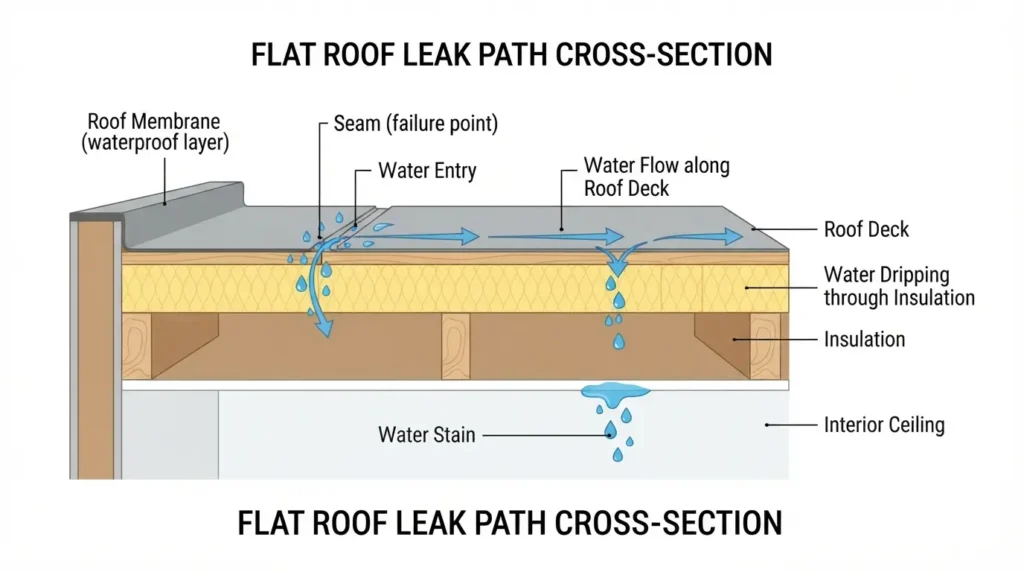
One detail catches most homeowners off guard. The water stain on your ceiling is rarely located directly under the actual leak. Water often travels sideways along the deck before dropping through a seam or fastener. If a visual inspection cannot find the entry point, a moisture scan is usually faster than guessing.
Seasonal Flat Roof Maintenance Calendar
Different seasons create different risks for a flat roof. A seasonal routine keeps small issues from becoming big ones.Maintenance needs vary by climate. Hot, dry regions prioritize UV protection. Cold, wet regions prioritize drainage and ice management.

Spring Maintenance Tasks
Clear all winter debris. Inspect flashing and seams for cracks caused by freeze and thaw cycles. Flow test every drain before spring storms begin.
Summer Maintenance Tasks
Watch for ponding after heavy rain. Check that HVAC service crews have not damaged the membrane. Keep foot traffic limited to designated walk pads, since UV exposure and heat make membranes softer.
Fall Maintenance Tasks
Sweep leaves weekly during peak leaf drop. Trim overhanging branches. Seal any small cracks before the first frost arrives.
Winter Maintenance Tasks
Monitor snow depth and weight. Watch for ice buildup near drains and edges. Check ceilings regularly for new staining, since leaks are harder to spot visually under snow cover.
Which Roof Coating Works on Your Membrane?
Coatings can extend a roof’s life, but only when matched correctly to the membrane underneath.
| Coating Type | Works Best On | Handles Standing Water | Key Caution |
| Acrylic | Modified bitumen, primed single ply | Poor | Not for roofs with ponding issues |
| Silicone | Most substrates with correct primer | Excellent | Can get slippery when wet |
| Polyurethane | High traffic areas, spray foam roofs | Good | Requires two coat application |
| Asphalt based | Built up and modified bitumen only | Poor | Will damage EPDM, TPO, and PVC |
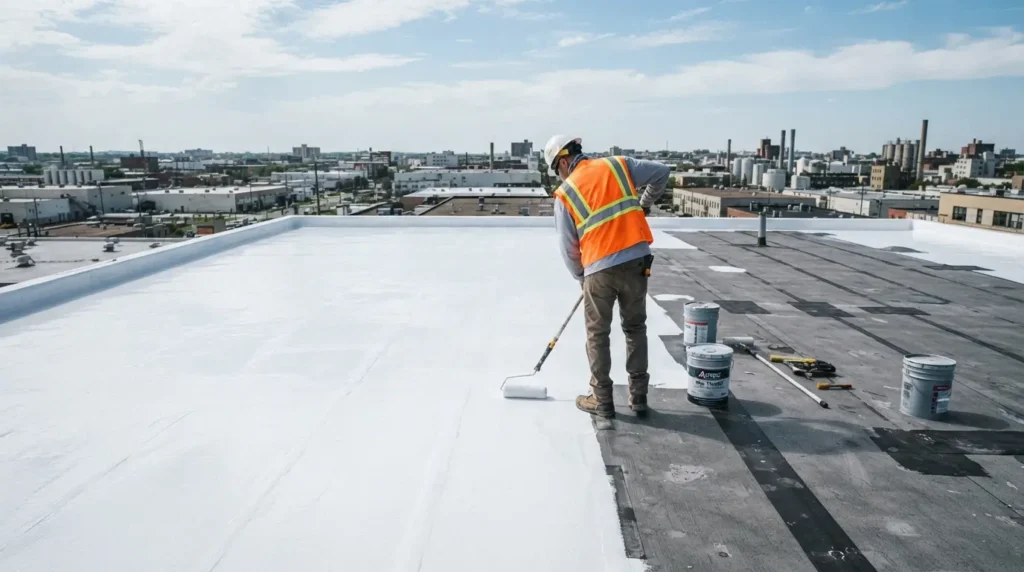
Never coat over a wet or damaged surface. Trapped moisture underneath a coating will rot the deck over time. Always confirm with your manufacturer that a coating will not void your existing warranty before applying anything. Coating decisions are a core part of long term flat roof maintenance planning.
What Should You Handle Yourself vs. Call a Professional?
Knowing your limits protects both your roof and your safety.
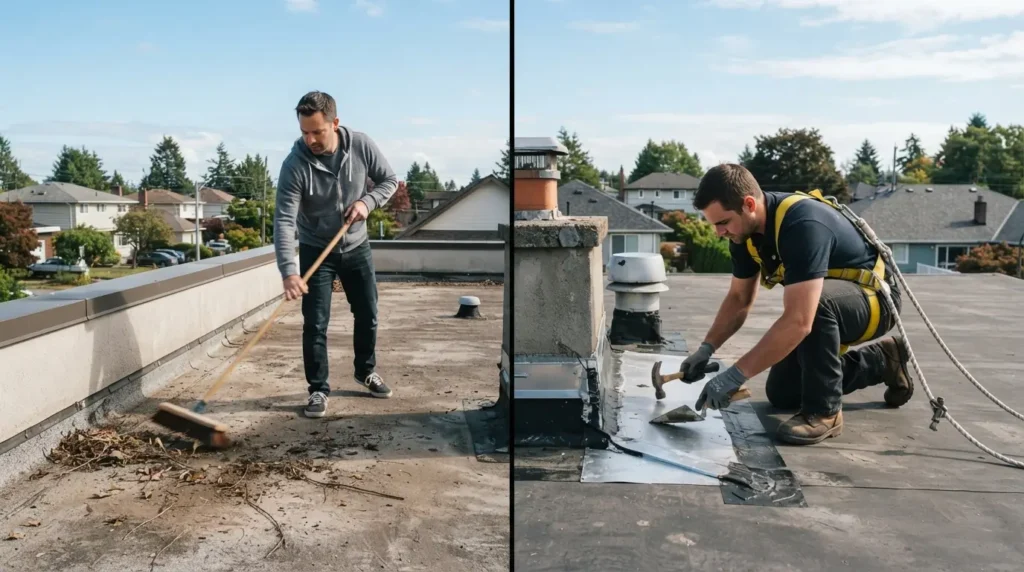
Reasonable DIY Tasks
- Clearing debris and drains
- Visual inspections with photos
- Gentle moss removal with membrane safe cleaners
- Trimming nearby branches
When to Call a Professional
- Any seam, flashing, or drain repair
- Wet or spongy insulation
- Repeated ponding in the same spot
- Punctures larger than a coin
- Anything covered under an active warranty
What Does Professional Flat Roof Maintenance Cost?
Routine professional flat roof maintenance typically costs between four and thirteen dollars per square foot. Full replacement runs much higher, often between seven and thirty dollars per square foot. Booking one professional inspection per year, alongside your own checks, is usually enough to catch problems early and keep warranty coverage active.
The Real Cost of Skipping Maintenance
Clearing a blocked drain costs very little. It might take an hour and a few dollars in supplies. Ignoring that same blocked drain can lead to trapped water, soaked insulation, and a section of roof that needs full replacement. A repair that would have cost a few hundred dollars can turn into a project costing thousands. This gap is the entire reason flat roof maintenance pays for itself. Small, consistent effort protects a much larger investment.
Common Flat Roof Problems and How to Fix Them
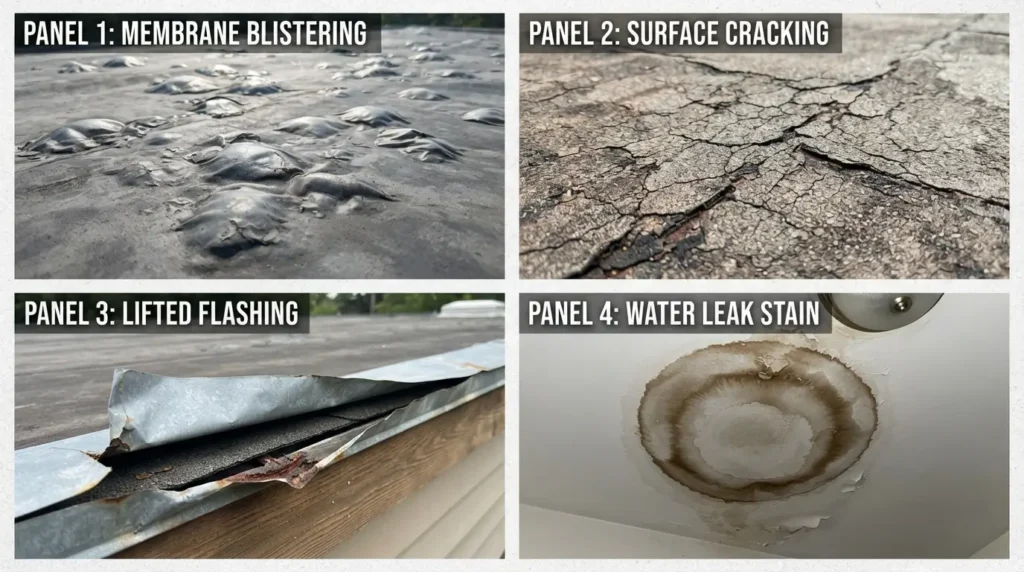
Leaks
Leaks usually start small and grow quietly. Locate the source using both interior and rooftop inspection, since water often travels before it drops. Clean, dry, and patch the area with a membrane compatible sealant.
Ponding Water
Persistent ponding points to a slope or drainage design issue. Clearing debris helps short term, but repeated ponding in the same location usually needs tapered insulation or an added drain.
Blistering and Cracking
Small blisters that are not leaking should usually be left alone and monitored. Cutting one open turns a sealed defect into an open hole. Cracks should be cleaned, filled, and reinforced if needed.
Weather and Wind Damage
UV exposure breaks down membranes over time. Temperature swings cause expansion and contraction, which stresses seams. High wind can lift edges and loosen flashing. Regular inspection catches this early, before it becomes a leak.
Overloading
Snow, ice, and unauthorized rooftop equipment can add serious weight to a flat roof. Watch for sagging ceilings, sticking doors, or unusual cracking sounds inside the building. These are warning signs of an overloaded structure and should be treated seriously.
Seven Mistakes That Shorten a Flat Roof’s Life
- Using asphalt based products on EPDM, TPO, or PVC membranes
- Pressure washing the roof surface
- Letting other trades walk the roof without protection
- Ignoring the secondary or overflow drain system
- Coating over trapped moisture
- Letting moss and plants grow in seams
- Skipping documentation for inspections and repairs
Avoiding these seven habits prevents most premature roof failures. Each one reflects a basic flat roof maintenance principle that gets overlooked under time pressure.
Protecting Your Warranty: What to Document
Manufacturer warranties almost always require proof of regular maintenance. A roof file should include the original installation details, the membrane type, and the warranty certificate. Add every inspection report with dated photos. Record every repair, including the date, location, and materials used. This file protects your warranty claim and helps any contractor diagnose recurring problems faster.
Repair or Replace: How Do You Know Which One You Need?
Maintenance stops being effective once the underlying structure is compromised. Replacement usually makes more sense when a moisture scan shows a large section of wet insulation. It also applies when the deck feels soft or visibly sags. New leaks appearing in different spots each season, rather than the same one, is another sign the membrane is failing broadly. If annual repair costs are climbing close to a meaningful share of full replacement cost, replacement is usually the smarter long term choice.
Free Flat Roof Maintenance Checklist
Use this simple checklist twice a year, and after any major storm.
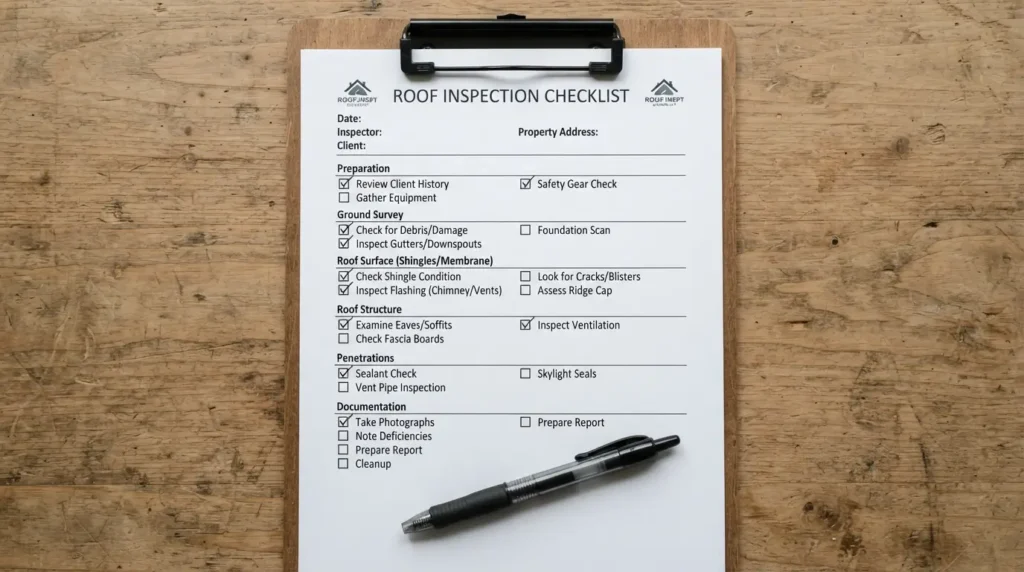
- Inspect the full roof surface for cracks, blisters, and soft spots
- Clear all debris from the roof and drains
- Flow test every drain, including overflow systems
- Check flashing around all penetrations
- Photograph any changes for your records
- Trim overhanging branches
- Confirm no standing water remains after 48 hours
Frequently Asked Questions
How often should a flat roof be inspected?
Twice a year is the standard, ideally in spring and fall. Add an inspection after any major storm or hail event.
How long does a flat roof last?
Most modern membranes last between 15 and 30 years, depending on material, installation quality, and maintenance history.
Can I walk on my flat roof?
Yes, but only occasionally and carefully. Use walk pads where available and avoid extreme heat or freezing conditions.
Is standing water on a flat roof normal?
Briefly, yes. Water still present 48 hours after rain signals a drainage or slope problem.
How much does flat roof maintenance cost?
Routine professional maintenance usually costs between four and thirteen dollars per square foot.
Will regular maintenance keep my warranty valid?
In most cases, yes. Manufacturer warranties commonly require documented, regular maintenance to stay active.
Key Takeaways
Flat roof maintenance comes down to a few consistent habits. Know your membrane type before using any product on it. Keep water moving off the roof within 48 hours. Watch seams, flashing, and drains closely, since that is where nearly every leak begins. Document every inspection and repair to protect your warranty. These small, repeated actions are what separate a roof that reaches its full lifespan from one that fails early.

About HomeFixStyle
HomeFixStyle is a home improvement blog dedicated to helping readers create better, more comfortable, and stylish homes. We share practical ideas, helpful guides, home decor inspiration, renovation tips, and simple solutions for everyday home projects. Our goal is to make home improvement easier to understand and apply, whether you are updating one room or improving your entire home.