
Tan has a reputation problem. Ask ten people what they picture when you say “tan bedroom” and half of them will describe a builder-grade rental unit from 2009. That’s not tan’s fault — it’s what happens when the color gets picked without thought for undertone, lighting, or contrast.
Done right, tan is one of the more forgiving neutrals you can put on a bedroom wall. It reads warm without going orange, pairs with almost anything, and doesn’t date the way trend colors do. I’ve worked through enough paint consultations and repaints to know where tan goes wrong, and it’s almost always one of three things: the wrong undertone for the room’s light, no contrast anywhere else in the space, or furniture and bedding that match the wall so closely the whole room flattens into one tone.
This guide covers how to choose a tan that won’t fight your lighting, how to layer color and texture around it, and which combinations consistently work in real bedrooms — not just in a paint swatch under a showroom light.
What “Tan” Actually Means in Paint and Design
Tan sits between beige and light brown on the color wheel, usually with a yellow, orange, or reddish undertone. It’s part of the broader warm-neutral family that also includes greige, taupe, camel, and sand — but tan specifically leans warmer and slightly darker than most beiges.
The confusion people run into is that “tan” isn’t one color. A paint chip labeled tan from one brand can look almost gold in daylight and slightly pink under a warm bulb. That’s why undertone matters more than the name on the swatch.
Common Tan Undertones
- Yellow-based tan — reads cheerful and golden, works well in rooms with limited natural light
- Red or pink-based tan — leans closer to terracotta or clay, adds warmth but can look dusty rose in low light
- Gray-based tan (often called “greige”) — the most versatile, reads more neutral and modern
- Orange-based tan — the riskiest of the group, can tip into a dated, builder-beige look if overused
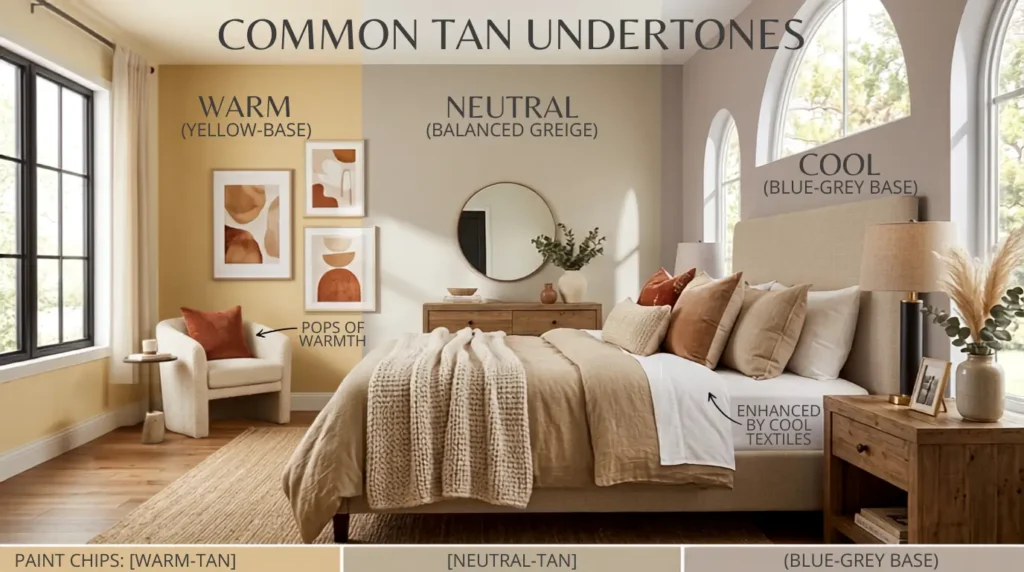
Before committing to a full room, paint a sample on two or three walls and check it at 9 a.m., midday, and after sunset. A tan that looks perfect at noon can turn muddy under a warm-toned lamp at night.
Choosing the Right Tan for Your Bedroom’s Light
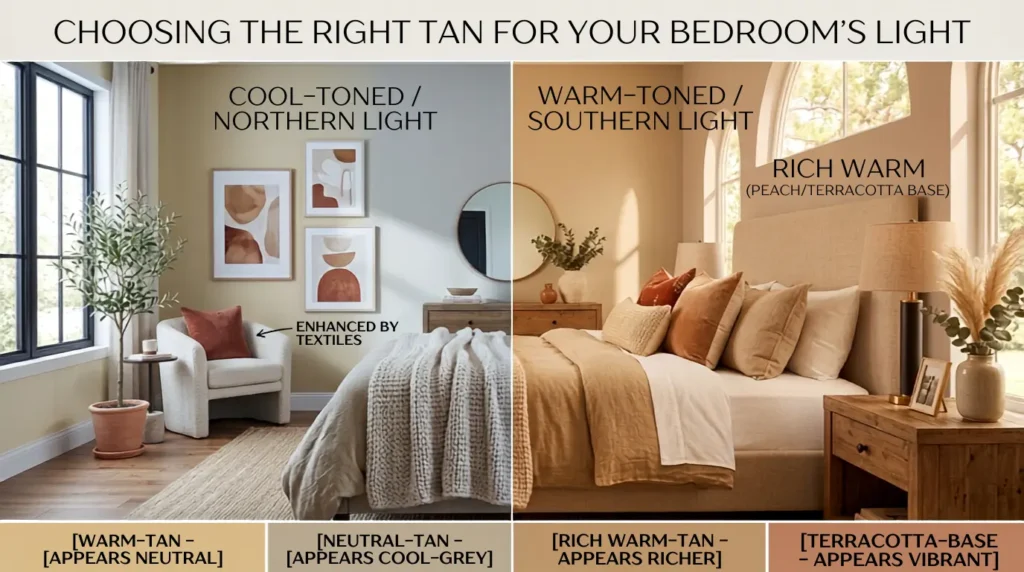
North-facing bedrooms get cooler, bluer light throughout the day, which can make tan look flatter and grayer than expected. South-facing rooms get warm, golden light that intensifies a tan’s undertone — sometimes past the point you want.
For rooms with limited natural light: lean toward a yellow-based tan with a higher light reflectance value (LRV). Anything under an LRV of 40 in a dim room risks feeling like a cave by evening.
For bright, south-facing rooms: a gray-based tan keeps things from feeling overly warm or saturated once the afternoon sun hits the wall directly.
For rooms lit mostly by lamps at night: test your tan under the actual bulbs you’ll use. Warm LED (2700K) will push any tan warmer; cooler LED (3500K+) will neutralize it.
This is the step most people skip, and it’s the one that determines whether the color feels intentional or accidental six months later.
Tan Bedroom Color Palettes That Work
Tan on its own can feel unfinished. It needs at least one contrasting element — trim, bedding, or an accent wall — to keep the room from reading as one flat block of color.
Comparison: Tan Pairing Options
| Pairing Color | Mood | Best For |
| Cream or off-white trim | Soft, classic, timeless | Traditional or transitional bedrooms |
| Charcoal or deep navy accents | Grounded, modern contrast | Rooms that want a “designed” feel, not just neutral |
| Sage or olive green | Earthy, calming, on-trend | Nature-inspired or biophilic bedrooms |
| Terracotta or rust textiles | Warm, layered, cozy | Southwestern, Mediterranean, or boho styles |
| Black metal fixtures | Sharp, modern edge | Minimalist or industrial-leaning spaces |
| Dusty blue bedding | Cooling balance to a warm wall | Rooms that run warm or get strong afternoon sun |
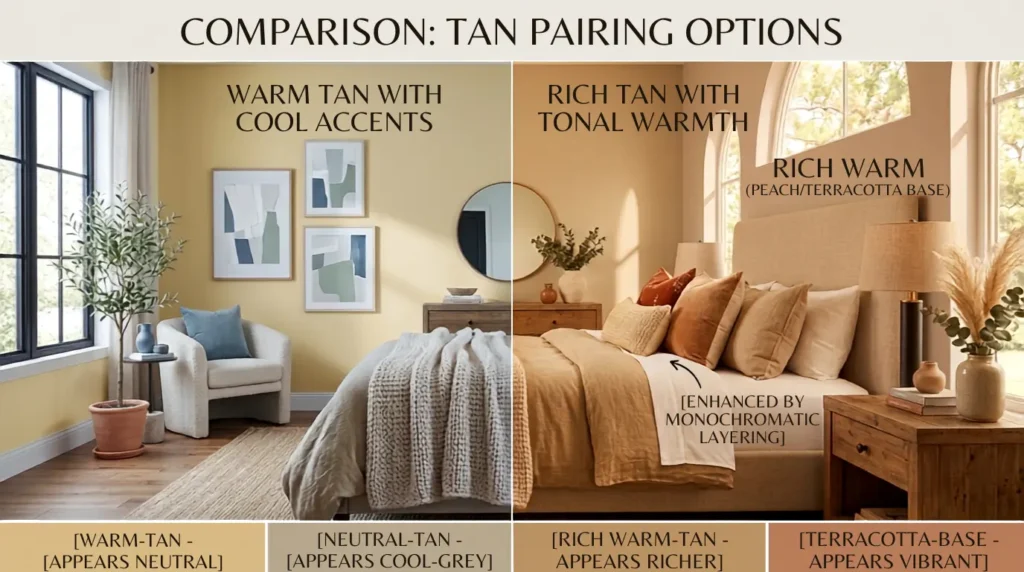
A simple rule that holds up across most rooms: if your tan leans warm, balance it with one cool element somewhere in the room — bedding, a rug, or a piece of art. If your tan leans neutral-gray, you have more room to layer additional warm tones without the space feeling heavy.
Furniture and Materials That Complement Tan Walls
Tan is a backdrop color, not a statement color, which means the materials in the room carry more visual weight than the wall itself.
Wood tones: Walnut and dark oak create clear contrast against tan and tend to look more intentional than furniture in a matching honey-oak tone, which can blur into the wall.
Metal finishes: Matte black, aged brass, and brushed bronze all read well against tan. Chrome tends to look cold and out of place next to a warm neutral.
Textiles: Linen, boucle, and heavier woven cotton add texture that a smooth tan wall doesn’t provide on its own. A tan room with no textural variation in the bedding or rug will look flat in photos even if it feels fine in person.
Rugs: A patterned or differently-toned rug is one of the easiest ways to keep a tan-and-neutral bedroom from feeling monochrome. Solid tan rug on tan floor on tan wall is the combination that most often gets described as “boring.”

Common Mistakes in Tan Bedrooms
- Matching everything too closely. Walls, bedding, curtains, and furniture all in the same tan family removes all depth from the room.
- Ignoring the ceiling. A stark white ceiling against a tan wall can look unfinished; many designers now recommend a soft off-white or a very pale version of the wall color for the ceiling instead.
- Skipping trim contrast. Painting trim the same color as the wall (increasingly popular in monochromatic schemes) works for some rooms, but in a tan bedroom it often removes the architectural definition the room needs.
- Not testing under nighttime lighting. A bedroom is used at night more than during the day, and tan behaves very differently under a warm bulb than under daylight.
- Choosing tan because it’s “safe.” Tan chosen out of indecision, without attention to undertone or lighting, is usually the version that ends up looking dated.

A Quick Framework for Planning a Tan Bedroom
- Identify your room’s natural light direction (north, south, east, west).
- Test two or three tan swatches on the actual wall, not just a paint chip in hand.
- Check the swatches morning, midday, and night under your real light bulbs.
- Pick one contrast color for trim, bedding, or an accent wall.
- Add at least one textured element — a woven rug, linen bedding, or a wood headboard.
- Confirm the ceiling and trim colors before finalizing the wall color, not after.
Following this order avoids the most common outcome: painting the wall first, then trying to force the rest of the room to match a color that was chosen in isolation.
Frequently Asked Questions
Is tan still in style for bedrooms in 2026?
Yes, particularly gray-based and warm neutral tans paired with deeper accent colors like olive, charcoal, or rust. What’s fallen out of favor is flat, orange-leaning “builder tan” used without any contrast elsewhere in the room.
What color trim goes best with tan bedroom walls?
Cream or soft white trim is the most reliable pairing for a classic look. For a more modern feel, matching the trim closely to the wall color (a monochromatic scheme) or using a deep charcoal trim for contrast both work, depending on the style you’re going for.
Does tan make a small bedroom feel smaller?
Not inherently. A tan with a higher LRV (light reflectance value) will keep a small room feeling open, while a deep, saturated tan can make a small space feel more enclosed. Pairing tan with a lighter ceiling and trim also helps a small room feel taller.
What bedding colors work with tan walls?
Cream, white, sage green, dusty blue, and deep terracotta all pair well. The general guidance is to avoid bedding in the exact same tan tone as the walls, since it removes contrast and can make the whole room look unfinished.
Is tan a warm or cool color?
Tan is generally considered a warm neutral, though the exact undertone (yellow, red, or gray-based) determines how warm or cool it reads in a given room.
What’s the difference between tan and beige?
Beige tends to be lighter and cooler, while tan is typically a shade or two darker with a more pronounced warm undertone. In practice, many paint brands use the terms loosely, so checking the LRV and undertone matters more than the label.